

Showing posts with label growth rate. Show all posts
Showing posts with label growth rate. Show all posts
March 29, 2013

March 26, 2013
What is a 'baby' sized green?
There is no standard size to define what is considered a 'baby' sized salad green - at least I haven't seen one yet. So I made up my own set of parameters based on observation, salad eating and a few reliable sources. Johnny's Select Seeds suggests harvesting salad greens at 4-5 inches tall which translates to 10.16- 12.7cm. I feel like Eliot Coleman of Four Season's Farm wrote that he harvests salad greens at 4 inches, but since I can't find that anywhere in my notes I could be wrong.

For harvesting and data analysis I consider lettuce and brassicas in the 8-12cm range a good size for baby greens.

Currently, I consider 6-10cm perfect size for spinach. Unlike lettuce and brassicas, spinach has an official size: the size of a soup-spoon (again I can't find my notes on this right now). I don't have real soup spoons, but hopefully a tablespoon is an ok substitute.

Share this post


February 26, 2013
How I use growing degree units
A few weeks ago I described how to calculated growing degree units. Remember? Basically they are a measure of heat accumulation, and pretty useful when you're dealing with changing seasons, night and day, or greenhouses heated to different temperatures. Here's how I use them.

We'll use lettuce as an example. I planted lettuce nine time throughout the fall last year. Using all the growth rate data I collected I figured out how many days it took to reach 8 cm. (8cm is a good baby green size.) In the graph below you can see that it took more days to reach 8cm as the season changed from fall to winter, especially in the cooler greenhouse.

Still on board?
I did the same thing, but changed growing degree units for days. So, I calculated how many growing degree units it took for the lettuce to reach 8cm. The number of growing degree units accumulated by lettuce at 8cm stayed about the same in the warmer greenhouse and slightly decreased in the cooler greenhouse - even though the actual amount of time to reach this size increased. Make sense?

So, now on to interpretation. Why does this happen and what does it mean? I'm not totally sure yet, but here are some ideas:
- It takes about 600 GDU to have a harvestable baby lettuce crop. How long it takes to accumulate that heat can vary.
- Why does the number of GDU decrease in the cooler greenhouse? Maybe because there is so little light late in the fall. Even if greens were in a warm environment, their growth would be limited due to limited light.
* As usual, this data pertains only to our greenhouses this fall. It is not complete and should not be used elsewhere. If you are looking for complete data pertaining to winter greens growth, and growing degree units you'll just have to wait until I'm done with my thesis! *
Share this post
February 22, 2013
What I'm eating today - the first harvest of the year

Yesterday I harvested the first greens of the year. I planted the mizuna a month ago and the handful I harvested was just enough to cover a pizza.

Share this post
January 18, 2013
Fall fuel use
While sifting through all the growth rate data I collected last fall, one thing I'm looking at is fuel use, and if using more fuel to speed up growth rate is cost effective.


The greenhouses are heated by a furnace that blows hot air out (left). They have a meter on them (right) that shows how many hours the blower has actually been blowing air out. I record the number twice a week. Since the meter is continuous I adjust the numbers to reflect the number of hours it was on for my particular experiment. Oh-so-conveniently, the furnace uses one gallon of fuel every hour, so I also convert "hours" to "gallons."

The above chart shows total fuel use in each greenhouse. Greenhouse one is heated to a 40 degree (F) minima and greenhouse two is heated to a 50 degree minima. This doesn't mean that each greenhouse is at a constant temperature, it means the temperature will not fall below the given set point. You can see this created a big difference in how much fuel was used.
Since 'gallons of fuel' is a bit arbitrary to the non-greenhouse owner, lets attach monetary values (everyone understands dollar signs). So,
Greenhouse 1: 108gal x 3$/gal = $324
Greenhouse 2: 264gal x 3$/gal = $792
* As usual, this data pertains only to our greenhouses this fall. It is not complete and should not be used elsewhere. If you are looking for data pertaining to winter greens growth, fuel use and temperature you'll just have to wait until I'm done with my thesis! *
Share this post
January 11, 2013
How to analyze growth rate
I know you are agog with curiosity wondering how I am using the quadratic equation. By using it I feel like I am fulfilling every math teachers dream. This post will be a bit math heavy - just think of it as a way to ward off dementia. Plus, this is the whole point of what I am doing, so it's pretty important.

First, the data I'm using is from mizuna planted on September 18th. Second, remember that I measure growth rate by measuring leaf length of the greens twice a week. The above chart shows those measures condensed over time. Each vertical line of dots is one day. You can see what a range of leaf lengths there are in plants sown on the same day and that as leaf length increases with time.


But, no, it's time to add a quadratic curve (in green). Quadratic equations are curvy, which is why the equations describing them are more complex and involve squared values. See:
Leaf length (cm) = -3.41 + 0.64*DAS -
0.02*(DAS-21.49)2
The quadratic line fits the data better than the linear line (just trust me), so that's what I should use.

Finally, we've gotten to the point - how to use these equations! (If you've made it this far I commend you.) I've determined that the best size for baby salad greens is between 6 and 12 cm (purple dotted lines on the chart above). Using the linear and quadratic equations I can figure out how many days it takes for mizuna to reach these sizes. Just looking at the chart, it takes mizuna about 16 days to reach 6cm and about 24 days for it to reach 12cm. I'd say that is enough for a Friday morning right?
Share this post
January 7, 2013
What I'm eating today ~ 1/7

Last week I commented on not knowing what to do without any salad greens in the house. In truth, we have bags of frozen spinach that were harvested before downy mildew took over and are not totally bereft of green things to eat. I've also watered the nearly-dried-out greens that were left to fend for themselves in the greenhouses during Christmas break. So, soon I'll be back in business.
In the meantime, I'm wrestling with the quadratic equation. If you haven't thought about this since high school (like me!) it looks like this: Ax2 + Bx + C = Y or this: X = (-B +/- √(-B – 4AC)) /(2A). I'm using it to look at all the growth rate data from the fall. So far it's a bit headache-inducing, but makes me glad I've hung onto my TI-83. (For anyone older than me I think you used slide rules to do algebra? Wikipedia describes slide rules as 'mechanical analog computers,' which sounds like a term that would get you shoved into a locker).
Share this post
December 18, 2012
Peronospora farinosa - downy mildew

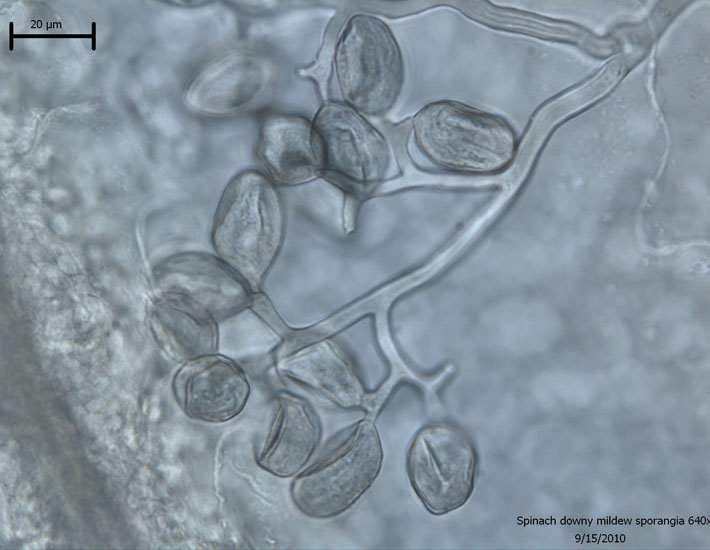 |
| http://mtvernon.wsu.edu/path_team/DiseaseGallery/spinach-downy-mildew-4.htm |
 |
| The fungus 'ate' through these leaves! Gross! |
- Leave the greenhouses spinach free for at least two weeks. Downy mildew is specific to spinach. Without a host it should die.
- Sanitize the flats I use to grow greens in. At the end of the season they are pretty dirty and the plant residues on them could harbor spores.
- Use a spinach variety that is resistant to more strains of downy mildew. Since it is such a widespread problem, new varieties of spinach are bred to be more resistant. Space, the variety I have been using, is resistant to strains 1-3. In the spring I'll use a variety that is resistant to at least strains 1-7.
Share this post
November 16, 2012
Photo friday

This spinach leaf seemed to be waving as I took pictures yesterday. The later planted greens are just beautiful with wide leaves, and good germination. These ones here were planted October 15th. The photos below show their growth from seedling to baby green size.


Share this post
October 3, 2012
Growth rate observations - problems

Not all things are happy and cute (like microgreens) in the greenhouse. Here are some of the problems I've observed in the past few weeks. In the picture above the lettuce is substantially smaller than other lettuce planted in the tray next to it (you can't actually see that from the picture, you'll just have to take my word for it). The spinach germinated very poorly. Look at all that dirt! Since I use the vacuum seeder to plant I know there should be more spinach growing.

Next up, curly spinach leaves. The leaves were also curling from the edges in, making them look like long, skinny green scrolls. Who wants to eat that? Potentially, it was due to the very, very low light levels this weekend. See how long and stretched the mizuna seedlings are below? That's also due to low light levels. None of the plants are hurt. Since there was a bit of sun in the past few days the spinach leaves have uncurled.

Share this post
September 28, 2012
Photo Friday
 |
| Seedlings of bulls blood beet in the foreground, and tokyo bekana in the background. |
 |
| What greenhouse one looks like. Flats of spinach, lettuce and mizuna for the growth rate project in the foreground, and newly seeded flats for the variety trials in the background. |
Share this post
September 25, 2012
A graph a day keeps the doctor away
Only three harvests in, and already I'm seeing some interesting data! I'm growing spinach, lettuce and mizuna for the growth rate project in two greenhouses. In greenhouse one the heat turns on when outside temperatures fall below 50 degrees. In greenhouse two the heat turns on at 40 degrees.

Recently, night time temperatures have been in the forties so the heat has turned on in one greenhouse but not the other. Consequently, the greens have grown taller and weigh more in the warmer greenhouse. Since there are only three data points I can't really make any real conclusions until more data is collected.

Share this post
September 21, 2012
First harvest of the season
 |
| Planted September 4th, just 17 days ago! |
 |
| Planted September 11th, 10 days ago. |
Share this post
September 18, 2012
Leaf length and harvest weight - why measure both?

Today was the first day of data collection for the season and it's only been two weeks since planting! (Two week old greens on the left, one week old greens on the right.) Like last spring I measure ten leaf lengths per quadrant and then measure the weight of all the greens in that quadrant.

So, why measure both?
Leaf length indicates when greens are ready to be harvested. With a quick glance at a tray of greens I can say 'those are big enough to harvest' or 'those are still too small to harvest.' I've found that between 6 and 10 centimeters is about the perfect size for baby greens. A lot of the greens I'm growing can, and will get bigger than that, but then are too big to be 'baby' sized.
Harvest weight, which I measure in grams per square meter, is important because salad greens are priced by weight. Right now the price of mesculun mix at farmers markets is about $12 per pound. So, knowing how the weight of the greens increases as they grow will be important for budgeting analysis (when I get to that step!). For example, 6 cm long greens will weight less than 10 cm long greens. So, if you let your greens grow more you could make a larger profit.
Share this post
September 9, 2012
First seedlings of the year

After just a few days mizuna and lettuce seedlings are popping up.
No signs of any spinach yet, but it has been sunny and warm in the greenhouses.

Share this post
September 6, 2012
The fall plan for wintergreen's
This past week it sometimes feels like fall. Partly because I choose to wear shirts with actual sleeves, but mostly because I planted the first crop of spinach, lettuce and mizuna for the fall! In the coming months I will be doing three major projects to expand on the data I already have and to address some new questions.
 First I'll be looking at growth rate of greens throughout the fall, early winter and early spring. This will be the same as the growth rate study I did during spring 2011, but instead of looking at the growth rate of ten varieties of greens I'll only be following three. (For more on good old spinach, lettuce and mizuna see here). I'll plant these three greens eight times in the next two months and take leaf length and harvest weight measurements throughout their lifespan.
  Next, I'm going to try using different types of media to see how they affect yield. So far I've grown everything in super nice, but very expensive compost. What about less expensive compost? Or potting soil (which is what growers often have on hand)? Or potting soil with slow release fertilizer? Again I'll be using spinach, lettuce and mizuna and again I'll be measuring their growth rate using leaf length and harvest weight.
Last, (and most exciting!) I'm going to do a variety trial of 25 different greens that are cool weather tolerant. Some will be greens I grew last spring like tokyo bekana, tatsoi and outrageous lettuce. But there are going to be a lot of new varieties that I've never heard of before like tatsoi savoy, wasabina and white russian kale. And of course vitamin green, which seems to be what most people want to know about anyway.
Share this post
July 23, 2012
Help needed!
In the coming fall and spring I'll be looking in depth at the growth rate of six greens throughout the season. The list includes: mizuna, tokyo bekana, tatsoi, spinach, and green romaine lettuce. I need help picking the sixth variety. Here are the options:
What do you think? Are there other varieties you think should be on the list? Leave me a comment (via facebook or the little pencil on the actual post) or send an email. I can see how many people view the post so I know when you're not replying! It's for science!
(I will be doing a variety trial of 20 greens once in the fall and once in the spring to look at lesser known varieties like vitamin green and tatsai.)
 |
| Scarlet frills: red, curly leaves, from the brassica family, has a mustard-y flavor that can be a bit spicy when weather is warm. |
 |
Red russian kale: Also a brassica, known for being cold weather hardy,
usually grown for mature leaves (not baby size for salads).
|
What do you think? Are there other varieties you think should be on the list? Leave me a comment (via facebook or the little pencil on the actual post) or send an email. I can see how many people view the post so I know when you're not replying! It's for science!
(I will be doing a variety trial of 20 greens once in the fall and once in the spring to look at lesser known varieties like vitamin green and tatsai.)
Share this post
June 19, 2012
Growth rate research questions
Since my growing season is over, and I no longer have any plants in the greenhouse, most of my time is spent organizing data, writing and trying to answer all my research questions. I have lots of questions. The ones below pertain only to the growth rate of greens and the economic of growing them because that's what I am thinking about right now.

Share this post
May 27, 2012
Basil!
I have been staring at pages and pages of numbers for the past few days. Since most of my plants have gone to the compost pile I don't have much to excite me . . . except trays full of basil!

Aren't they cute? This picture is from months ago. Basil does not grow very quickly, especially when it is not very warm out. I wouldn't really call it a 'wintergreen.' It definitely falls into the summer herb category.

I planted these on March 20th and have been watching and measuring them ever since. They were started in a tray of composted and transplanted into a plug tray or a tray of compost when they had two leaves. I doubt this is the preferred method of planting. When I was seeding them they all fell into the soil and leaving them there seemed better than rooting around trying to get them out. Transplanting worked just fine, and none of the seedlings seemed to suffer.

Basil is a nice, symmetric plant. In my notes I referred to their growth by how many sets of leaves the plant had. The picture above shows three sets of leaves on 36 day old plants.

By this time they were plugs with nice root systems. To give them more space to grow I re-planted them in either trays of compost (left) or pots of various sizes (right). (Growing basil is not really an organized experiment, so everything I do is just to see what happens.)


 |
| #1 |
And this!
 |
| #2 |
Oh no! Unhappy plants! Picture number one is from basil in a 6-pack (the kind of pot you buy pansy's in.) Number two is the tray of plants that I transplanted directly and didn't put into a plug tray. Confused? Really all the matters is that the basil plants were getting stressed out because they had used up all the nutrients in the compost. I stuck them in a new tray full of compost and they are much happier.

This week I'm wrapping up all my greenhouse experiments for the summer. I've already planted seven basil plants in the garden. The rest will go to other people's gardens, or towards making pesto (the real kind, not the brassica kind). I just read that basil can be propagated by cutting, so there will definitely be some basils in water on my window sill. Probably you'll here about it soon.
Share this post
Subscribe to:
Posts (Atom)