Showing posts with label problems. Show all posts

April 10, 2013

Colletotrichum: another spinach disease

I've been sick this week, and so is the spinach.   This new spinach disease is Colletotrichum (aka anthracnose).


Symptoms include: tan-brown circular lesions that coalesce  resulting in severe blighting of foliage.  Lesions can also be water-soaked, as in the below, righthand picture. Eventually diseased tissues are covered in small black fruiting bodies (the 'mushroom' part of the fungus).


Colletotrichum is seed borne, so using disease-free seeds is the best way to avoid it. I've heard washing seeds in hot water will kill this kind of disease, but I think you need a special seed-dishwasher.  (Does anyone know about seed washing?)

This is the second really gross disease spinach has had.  (Remember the downy mildew problem last fall?)  This leads me to a very bold idea:

Maybe spinach is not a good crop for bench-top winter growing.

Here's why:
  • Spinach is susceptible to many diseases when grown in greenhouses.  
  • Spinach is slow growing.  It has a slow turnover time.
  • Spinach takes a long time to harvest.
  • Spinach can have low yields per square meter. 

Note that I'm being specific to bench-top growing, and also that I said maybe.  There are big differences between bench-top growing in trays (what I'm doing) and in-ground growing (what farmers/gardeners do).

April 4, 2013

Releasing parasitic wasps!

The second biological control I released in my attack on the aphids  were Aphidius ervi wasps.  There were ordered from Biobest.  Parasitic wasps are SO COOL (this is coming from a girl who is terrified of yellow jackets and hornets).  
Source
As their name implies these wasps lay their eggs in aphids.  When the eggs hatch the new wasp goes through all it's juvenile life stages inside the aphid and eventually emerges as an adult, thus killing the aphid.  The dead aphid is called an aphid mummy.  You can see A. ervi in action below.  The aphids don't even seem scared.  Why aren't they running away?


The wasps come as eggs in aphids and are packed in buckwheat hulls (that's what you see in the photo below on the left).  I placed saucers of buckwheat and aphid eggs around the greenhouse and left them there for a week.  I had high hopes of seeing something exciting.


Alas, I have yet to see a wasp.  They are really small and they don't sting.  Other greenhouses on campus use these wasps to control aphids, which is how I took the picture on the right.  See how small they are?  If you're eating you might want to swallow your bite before watching the video below.  Pretty cool huh?

April 1, 2013

Releasing ladybugs!

In the past few weeks I've been working on part three of my attack on the aphids byt releasing ladybugs and parasitic wasps in the greenhouses.  It has been fun!


The ladybugs come from A-1 Unique Insect Control.  They came in a loosely woven cotton bag and were kept in a fridge prior to release.  I sprinkled them over the greens concentrating on areas that I knew had lots of aphids.  Once they warmed up the ladybugs became very active and few all over the place (even up my pants!).


Ladybugs are aphid eating machines, supposedly. I've tried really hard, but have yet to see any I've released actually eating an aphid.  The aphid population has decreased, so they must be doing something.  Eventually they settled down and then seem to spend all their time in warm spots.  Like the edges of trays or the sunny side of the greenhouse.

March 14, 2013

Attack on the Aphids


There were so many aphids in the greenhouse it was almost embarrassing.  Remember the pictures of leaves covered in aphids?  It was about time I did something to stop them. 


Goodbye greens!  This cart full of plants contained the very worst of the aphids.  So they got thrown out in the blue dumpster.  (Usually I compost everything, but the road to the compost pile is too mushy to drive on right now.)


Luckily the aphid infestation is in the non-organic certified greenhouse.  So, we sprayed two types of pesticide (by 'we' I mean the farm manager did the spraying).  The cocktail contained one part Botanigaurd and one part Azatin.  

BotaniGaurd is a mycoinsecticide, meaning spores adhere to the host and produce enzymes that dissolve the hosts cuticle.  

Azatin is an insect growth regulator.  When an aphid (and many other insects, fish and aquatic invertibrates) comes in contact with the pesticide it interferes with with the organisms ability to molt, thus killing it.  This is a pretty typical kind of pesticide.


Next week I'll release two beneficial insects: ladybugs and parasitic wasps.  They will control the aphids on a long term basis.  (The picture above is neither of these.  It's just an ordinary wasp on goldenrod.  I don't take many insect pictures.)  I'll write about them in detail next week when they get released.

March 13, 2013

Attack of the aphids

Last week I announced that there are aphids in the greenhouse.  By now there are more, lots more and we have begun a three-pronged attack on them.  But first, it's important to know just who we are dealing with.


The foxglove aphid, Aulacorthum solani, has a huge range of host plants and can transmit 45 diseases, so it's pretty bad.  The adult aphids are 1.5-3 mm long and are dull green or brown.  Their antenna are longer than their body and have dark joints.  Their legs also have dark joints and their cornicles are dark at the ends.  The picture below (which I did not take) shows all these characteristics really well. 

Photo taken by Andrew Jensen (aka Aphidman)
They like to colonize deep in plants on tender, young leaves.  I definitely found this to be true.  See how gross the young spinach leaves look?  What really kept me up at night is the reproductive rate of these aphids.  In just THREE DAYS the population doubles in a 55 degree environment.  How could I sleep when I knew aphids were busy multiplying that fast?  Happily, we've started attacking the problem.  You can look forwards to the next installment of "Attack of the aphids."


March 5, 2013

Aphids in the greenhouse


Aphids are a common problem, so it was just a matter of time before some wondered onto my greens.  At least that's what I'm telling myself now that I've found some lots.  Aphids are in the Homoptera order of the insect family.  Their distinguishing characteristic are two exhaust pipes, called cornicles, on their butts that secrete a warning scent when they are being attacked.  My camera is not powerful enough to take a picture of the cornicles, but you can see them here

January 20, 2013

New spinach variety

Source: Johnny's Seeds

I chose organic Corvair spinach to replace Space as the primary spinach variety for measuring growth rate.  See if you can guess why based on the High Mowing description:

"High level of downy mildew resistance. Smooth, oval leaves are medium to dark-green and upright for easy harvesting by hand or harvester. High yield potential and widely adapted for spring or fall productions." 

How many races of downy mildew is it resistant to? 11! Hopefully won't have to worry about downy mildew this year.  I also have some other varieties to try out including, emu and red cardinal.

December 18, 2012

Peronospora farinosa - downy mildew


 I left the spinach in the greenhouse for a few weeks after discovering downy mildew to watch what would happen.  I was not disappointed.  Besides turning fuzzy, the spinach leaves turned yellow and eventually shriveled up and died.

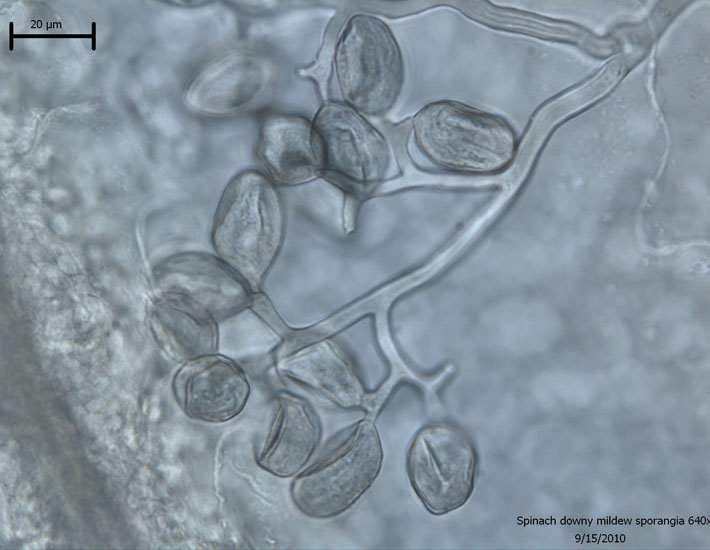
http://mtvernon.wsu.edu/path_team/DiseaseGallery/spinach-downy-mildew-4.htm
The above picture shows downy mildew sporangia, which I think must be what I called the 'fuzzy' grey stuff on the spinach leaves.  The sporangia is where the spores are formed.

The fungus 'ate' through these leaves! Gross!
What is the plan of attack for next semester?  Not growing spinach is not an option.

  1. Leave the greenhouses spinach free for at least two weeks.  Downy mildew is specific to spinach.  Without a host it should die.
  2. Sanitize the flats I use to grow greens in.  At the end of the season they are pretty dirty and the plant residues on them could harbor spores.
  3. Use a spinach variety that is resistant to more strains of downy mildew.  Since it is such a widespread problem, new varieties of spinach are bred to be more resistant.  Space, the variety I have been using, is resistant to strains 1-3.  In the spring I'll use a variety that is resistant to at least strains 1-7.

November 28, 2012

Tragedy in the greenhouse

My favorite green of all time is spinach.  And I have had no problems growing greens - until now.  It figures spinach would be the green to succumb to a pretty gross fungus. 


A few weeks ago I saw a leaf that looked like this.  Pretty gross huh?  It's downy mildew, or Peronospora farinosa, and is one of the biggest diseases that spinach has.  It spreads by spores so it travels fast.  How fast you ask?  When I came back after the weekend it was everywhere:


Gross!!!!  What you're seeing are the spores of the fungus and yellowing leaves that are a result of it.  I haven't had time to do proper research yet, but here are a few facts:
  1. If you've been eating the greens I grow don't worry!  I haven't been putting any spinach in for a while.  I'm pretty sure you'd be ok if you ate some downy mildew - but I'm not sure.  You should wash your greens anyways.
  2. This species of downy mildew is specific to spinach.  There are other species of downy mildew that attack lettuce but I forget the name right now.  Because of this I can leave the spinach in the greenhouse and watch it slowly die.  It's sad, the upcoming spinach crops were some of the best.
  3. Downy mildew likes moist, cool environments.  It's pretty happy in the greenhouses.